One of my favorite quotes in the New Testament comes from the interchange between Pontius Pilate and Jesus just before Jesus is condemned to death. “What is truth?” retorted Pilate. Quid est Veritas? Three simple words that can lead to a lifetime of inquiry.
In technical things, that’s how I feel when I look at data. Whether it is costing estimates, state vector estimates or some other information that is given to me, I also ask myself – “how confident am I in this data?”. I think my original suspicions of data accuracy was derived from early engineering school when we got the required lab lecture on accuracy and precision of measurements. Back in those days, few instruments had digital readouts and we had to interpolate analog readings. For the dwindling population of people who know what a slide rule is and the even smaller group that has actually used one – this is an important skill to possess. How accurate is my reading? But like many things in undergrad, I remembered the concept long enough to pass the test, forgot the concept and moved on to the real world.
Fast forward to 1990 and Specialized Undergraduate Navigation School (SUNT) at Mather AFB in Sacramento California. Accuracy and randomness were about to leave a major impression on my little brain. Side note – I always disliked the “Specialized” part of SUNT – we were a combined group of USAF, USN, USMC and International students going through aerial navigation training. I always thought it should be “Combined” vs “Specialized” but the acronym is extremely offensive. I get it. Moving on.
At Mather AFB, we were taught to estimate our aircraft position using “dead reckoning” techniques. We would regularly look at our heading, airspeed and sometimes drift angle if it was available, and log those data. When it was time to take an external “fix”, we would extrapolate and propagate those values from the navigation log to estimate our position by “dropping a DR”. Now a funny thing happened when we took an external fix. That fix wasn’t on top of the DR! Years later when I had two inertial navigation systems, a computer DR and one or more celestial fix – the fix often wasn’t anywhere near my DR position!
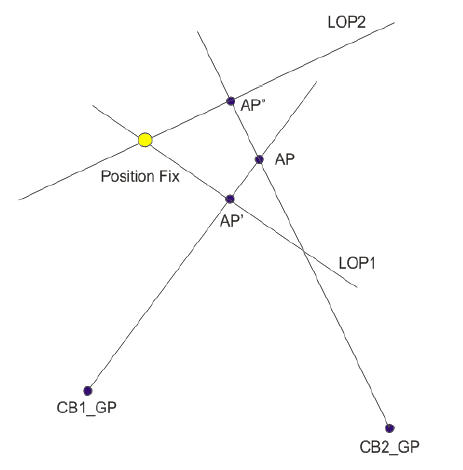
We used the Litton-72 Inertial Navigation System (INS) that integrated gyros and accelerometers to compute a highly accurate position estimation. But even those systems were only guaranteed to an accuracy of 2.5 nm/hr. We had two on board and I’ve seen the estimated positions vary between each other by tens of miles. Which one was right? Que est Veritas?